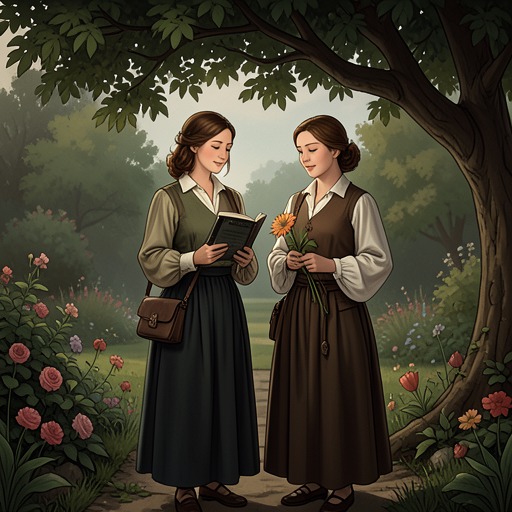
Phillipa Haymes—Ronald Haymes
A Murder Is AnnouncedPhillipa Haymes and Ronald Haymes’s marriage is a relationship shaped by separation, concealment, and a mistaken account of death. Phillipa initially describes herself as a young widow whose husband was killed in Italy, but the investigation later establishes that Ronald survived his desertion from the Army, returned to the area, and died only after rescuing a child from a lorry. The discovery revises the story Phillipa has told about her family and gives her son Harry a different inheritance of memory: his father’s death was not in Italy, and his final act was courageous.
Marriage and family
Phillipa recalls that she and Ronald married young and were, by her understated account, about as happy as most married people. Their son, Harry, was born before Ronald went overseas. Phillipa says that Ronald was killed in Italy, presenting the separation as a wartime bereavement rather than a continuing uncertainty. At this point in her account, Harry is the surviving centre of the marriage: when asked whether she now has Harry, she confirms that he is what remains of the family she and Ronald made.
The later disclosure that Ronald was alive after deserting makes Phillipa’s account more complicated than a simple lie. She says she does not tell Harry a heroic story about his father; instead, she avoids discussing the circumstances and says that, for them, his father was killed in the war. That formulation gives her a way to live with an absence whose actual cause she does not know. When pressed, she admits that Ronald may still be alive, but cannot say where he is or what became of him.
Separation, secrecy, and the investigation
The inquiry finds reason to doubt Phillipa’s assertion that she had not seen Ronald since he deserted from the Army. Craddock believes she was not telling the whole truth, and Rydesdale agrees. Ronald had apparently received money from his wife, a circumstance that links their separation to his later appearance in the neighbourhood. The evidence does not establish the details of their meetings, but it shows that their connection had not simply ended when he deserted.
A report that a man had been seen near the henhouse at Little Paddocks briefly draws attention to an apparent Army type. The man is identified as the detective, not Ronald; nevertheless, the detail sits within an investigation in which Ronald’s movements and possible connection to the hold-up are being considered. The eventual chronology rules him out: he was admitted to Milchester General on October 28, while the staged hold-up at Little Paddocks occurred on October 29.
Phillipa’s silence also reflects the uncertainty surrounding Ronald’s status. She had reason to think he might have been involved in the hold-up, yet, as Rydesdale observes, she would naturally have been reluctant to implicate her husband. Her reticence protects a family tie even while leaving investigators to interpret her account and the evidence for themselves.
Ronald’s death and its consequences
Rydesdale identifies Ronald as the unidentified man who had been taken to Milchester General after rescuing a child from beneath the wheels of a lorry and being struck himself. The man had no papers, and nobody had come forward to identify him. He died without regaining consciousness; only afterward was he recognized as Ronald Haymes, a deserter and former captain in the South Loamshires. An old Chipping Cleghorn bus ticket and a reasonable amount of money were found on him, details that help connect the unknown casualty to the local story and to the money Phillipa had apparently given him.
The date of the accident has decisive implications for the murder investigation. Because Ronald was already in hospital before the Little Paddocks hold-up, he could not have taken part in it. Phillipa, however, knew nothing of the accident and may have believed that her husband was implicated. The distinction between what she suspected and what had actually happened explains why her silence could appear incriminating without proving involvement.
Ronald’s last known action changes the moral weight of the account. Although he had deserted the Army, Rydesdale distinguishes that past from the courage of his attempt to save a child, describing the rescue as plucky and his death as a good one. Craddock is glad for Phillipa and Harry’s sake: Harry need not be ashamed of his father, and Phillipa will be able to marry again. The relationship thus ends not with the supposed death in Italy that Phillipa had repeated, but with the belated identification of Ronald and a final act that allows his family to remember him with less shame and greater clarity.
Significance of the relationship
The marriage’s place in the mystery comes from the gap between a public account and a private uncertainty. Phillipa’s story of a husband killed overseas conceals neither a known death nor a fully understood disappearance; she has lived without reliable knowledge of Ronald’s fate and has withheld the subject from Harry. The investigation closes that gap by identifying the unknown man and establishing the dates, while also separating Ronald from the Little Paddocks crime.
That resolution is both factual and familial. Ronald’s desertion remains part of his history, but it no longer defines the last account of him. His rescue of the child supplies a more honorable ending, and the revelation releases Phillipa from waiting on an uncertain possibility while giving Harry a truth about his father that his mother had not known how to tell.